
Burnout is a quiet crisis in SaaS customer support. As AI and automation absorb the routine tickets, human support teams are left handling the hardest, most emotionally loaded conversations in the business, and burnout, disengagement, and agent attrition are climbing as a result.
This article covers four causes of customer support burnout that standard wellbeing programs miss, and six practical, low-cost changes CX leaders can make to prevent burnout before it costs them their best people.
The pattern might be familiar: automation deflection rate goes up and cost per ticket goes down, which means your team should now be able to “focus on high-value conversations.”
But then engagement scores sag, and the human agent whose tickets used to get screenshotted for training hands in their notice without quite being able to say why.
You might implement the standard toolkit for treating burnout: a wellness program, a mental health day, maybe a headcount request. Six months later you’re in the same place, with a smaller team, wondering why none of it stuck.
The Standard Toolkit Treats Burnout as a Workload Problem. Too Much Demand, Not Enough Recovery.
That model isn’t wrong – it’s just describing a different job than the one your human agents are doing now.
Recent research on the structure of support work points to four causes of burnout that sit entirely outside the workload model, which is why workload fixes keep bouncing off them.
The good news is that all four are structural, structure is the thing you control, and most of the fixes cost approximately nothing.
Four Reasons Burnout Happens in Customer Support
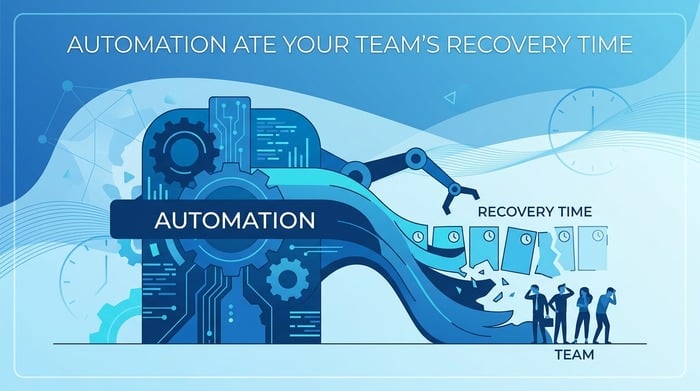
1. Automation Ate Your Team’s Recovery Time
The standard automation deployment sorts whole conversations.
Simple tickets go to the bot, complex ones go to humans – sounds sensible enough, right? Now look at what it does to a human agent’s actual day.
The easy tickets weren’t just cheap volume, they were breathing room.
A quick win, a grateful customer, a two-minute resolution between two brutal escalations: that variety spaces out the heavy interactions and gives people small, regular proof that they are good at the work they do.
Automated sorting removes exactly that.
What lands on your human team now is, by construction, everything the bot couldn’t handle.
Those are angry, ambiguous, and emotionally loaded conversations, and the kind of interactions where three departments’ mistakes concentrate in one furious message.
Your human agents aren’t handling difficult conversations alongside easy ones anymore. They’re handling difficult conversations instead of easy ones, back to back, all shift, every shift.
So when automation promises your team gets to “focus on high-value work,” the honest translation is that your people are now absorbing a concentrated stream of the hardest interactions in the business, with the natural recovery moments stripped out.
Same headcount, same hours, radically heavier diet.
And because the tickets that disappeared were the ones that made the dashboard look busy rather than the ones that made the day survivable, the change is close to invisible in your reporting.
2. Your Agents Take Hits They’re Not Allowed to Return
Sociologists use a concept called “face“: the social self-image everyone carries into every interaction and works to protect.
It’s why criticism stings, why being talked down to is unpleasant even when the content is accurate, and why we all soften requests with “sorry to bother you.”
You can also defend yourself from actions that threaten your face; this is called face protection and in normal life, it runs both ways.
If someone insults you at a dinner party, you can push back, set a boundary, or leave. You might choose not to, but the option exists, and knowing it exists is part of what makes the insult survivable.
Support work removes that option on one side only. The customer can be hostile, contemptuous, or manipulative with very little consequence.
The human agent cannot respond in kind, cannot walk away, and in some cases cannot even say “please don’t speak to me like that” without a QA flag.
This condition is called asymmetric face exposure:
The role of human support agent both maximises how much face threat a person absorbs, while prohibiting the face protection responses they’d have access to outside the support conversation.
Early on in their career, human agents experience this as an external rule. Annoying to experience, but it’s the job, and there’s still a gap between “what my job makes me do” and “who I am.”
Over time, though, the rule gets absorbed into their own definition of professionalism: a good agent doesn’t take rude or abusive behavior personally and stays calm no matter what.
The constraint becomes their own standard, and at that point they stop registering the abusive behavior as something that even warrants a response. Registering it would mean they’re bad at their job.
Listen for the person who shrugs “it’s fine, comes with the territory” about an interaction that would send anyone in Finance home for the day. That sentence is a symptom.
3. They Apologies, Personally, for Other People’s Mistakes
A big slice of inbound contact in any SaaS business is what is called failure demand: tickets caused by something happening upstream in the customer journey.
Think of Product deprecating a feature without notice, or Sales promising something the platform simply doesn’t do.
The customer’s anger or frustration at this discrepancy is real and understandable, and it lands on the one department in the company that had nothing to do with causing it to happen.
You don’t want your team to tell the customer so, because that would undermine their colleagues. They can’t tell the customer “Sales oversold this to you,” even when it’s plainly true.
They absorb responsibility for outcomes other departments generated, under an explicit (or sometimes inexplicit) rule against pointing at the actual cause.
Try saying the arrangement out loud in a leadership meeting: “we require our human agents to apologise multiple times a day, in their own voice and first person, for mistakes they didn’t make, and we score their sincerity while they do it.”
That’s a structural choice, not a communication style issue, and its running cost is currently hiding in your attrition line.
4. Your Best People Absorb the Most
This one is the most counterintuitive, and arguably the most expensive.
It’s easy to think that hostile interactions do the damage, and that the pleasant ones are neutral, maybe even restorative. Research argues it’s worse than that.
When a genuinely skilled agent achieves real emotional attunement with a customer, they lower the professional distance that would otherwise protect them from absorbing the emotional weight.
It allows the customer’s emotional reality all the way in. That’s exactly what excellent support looks like, and what your QA rubric rewards if it scores for empathy.
Therapists and nurses (professions in which similar absorption of that emotional reality happens) have processes in place to allow that weight to go somewhere: they debrief, decompress, and have supervision structures in place to keep balance.
That isn’t the norm within customer support. There, the weight gets absorbed and never discharged, and the human agents with the greatest capacity for attunement absorb the most.
Excellence and harm rise together.
Your top performer isn’t burning out despite being brilliant at relational work. The burnout is arriving through the brilliance.
Pull those four together and you get the reason for why the wellness program keeps underdelivering.
Classic burnout is a resource problem. Energy depletes with demand, replenishes with rest, and functioning follows a sawtooth pattern: down during crunch, up after a holiday. For genuine depletive burnout, the classic fix works like a charm.
The four mechanisms above damage something else.
These don’t drain a person’s battery so much as slowly reorganise their relationship to the work itself. Their professional identity, the one that made engagement possible, quietly rebuilds itself around self-protection instead.
The signature for this occupational corrosion is that rest stops working.
You may have already encountered it: an agent who takes two proper weeks off and comes back polite, punctual, and emotionally absent. The warmth doesn’t return, and they may seem even more disconnected to the work than before their break.
How to Prevent Burnout in Customer Support? Six Ways
You’ll notice that the list below does not mention resilience training, wellbeing apps, and anything else that asks your human team to cope harder.
Individual coping certainly has its place, but every mechanism above lives at the level of role design, measurement, and policy. Those are yours to change, and most of them are completely free. In rough order of impact:
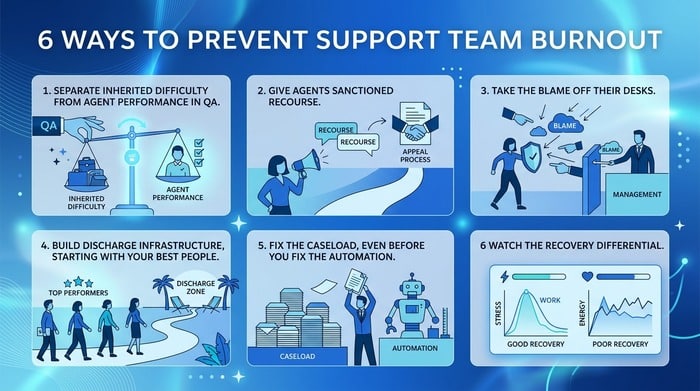
Separate inherited difficulty from agent performance in QA.
Before scoring how an agent handled a conversation, assess how hard it was when it arrived.
A human agent who takes a furious, thrice-escalated billing failure and lands it at merely dissatisfied has done elite work, and a rubric that scores the outcome against a standard resolution template punishes them for it.
If your QA can’t tell a hard conversation from a badly handled one, your QA is part of the corrosion machinery.
Give agents sanctioned recourse.
Written, leadership-backed authority to set boundaries with abusive customers, and to end interactions that cross a defined line, without a QA penalty and without having to chase down a manager first.
This kind of escape hatch may sound trivial and perhaps it’s already an unwritten rule for your team.
The emphasis on and the reminder that that hatch exists does some of that face protection for the team, and in some cases even does some restorative work.
Take the blame off their desks.
Track failure demand by originating function and put the numbers in front of the leaders who generate them.
Then loosen attribution rules as far as legal allows: “that was an error on our side and I understand the frustration” is honest, safe, and worlds away from a personal apology for someone else’s decision.
Support’s integrity is currently subsidising other departments’ mistakes. Send the invoice upstream.
Build discharge infrastructure, starting with your best people.
Debriefs after heavy interactions, structured peer support, protected decompression time that isn’t quietly contingent on the queue being clear.
Target the agents your QA scores highest on empathy first, because they’re likely carrying the most.
Fix the caseload, even before you fix the automation.
The longer-term move is deploying automation inside human-led conversations, carrying the routine informational load, rather than sorting whole tickets into human and machine piles.
If that’s out of reach this year, at minimum stop feeding anyone an unbroken diet of escalations.
Mix difficulty deliberately, rotate people through the heavy queues, and treat concentrated exposure as the occupational hazard it is.
Watch the recovery differential.
Add one question to your management cadence: is this person recovering when they rest?
Where the answer is no, chances are you’ve found corrosion. The best thing you can do to help is to provide structural change and visible backing, not another duvet day.
Your human team is now, by design, the part of the operation that absorbs everything the machines can’t. That can be sustainable, skilled, even career-defining work.
But only inside a structure built by someone who understands what the work actually costs.